How I Reset Our Home in 30 Minutes
Sometimes the house and I are both a little undone at the same time.
It's not that anything is catastrophically wrong. The dishes aren't piled to the ceiling. Nothing is broken. It just feels like too much — the clutter, the noise, the general sense that everything is slightly out of place, including me. And when you're already running on cold coffee and the last fumes of patience, even a messy counter can feel like one thing too many.
I used to have two options on those days: spiral into a three-hour deep clean I absolutely did not have the energy for, or ignore everything and feel vaguely guilty about it until bedtime.
Then I figured out the reset. And it changed things.
What "Reset" Actually Means
First, let me be clear about what a reset is not.
It's not a deep clean. It's not a reorganization. You're not pulling everything out of the pantry or mopping the floors or finally tackling the junk drawer that's basically its own ecosystem.
A reset is something smaller and more important than that. It's an emotional and physical refresh. There's a difference between cleaning (which removes mess) and resetting (which restores peace), and I think a lot of us have been defaulting to the wrong one.
Here's why this matters specifically for moms: our environment affects our mental load more than we realize. A chaotic space feeds a chaotic headspace. You can't always control what's hard in your life, but you can control what your living room looks like in the next five minutes. And that small act of agency? It does something.
The 5 Zone Method
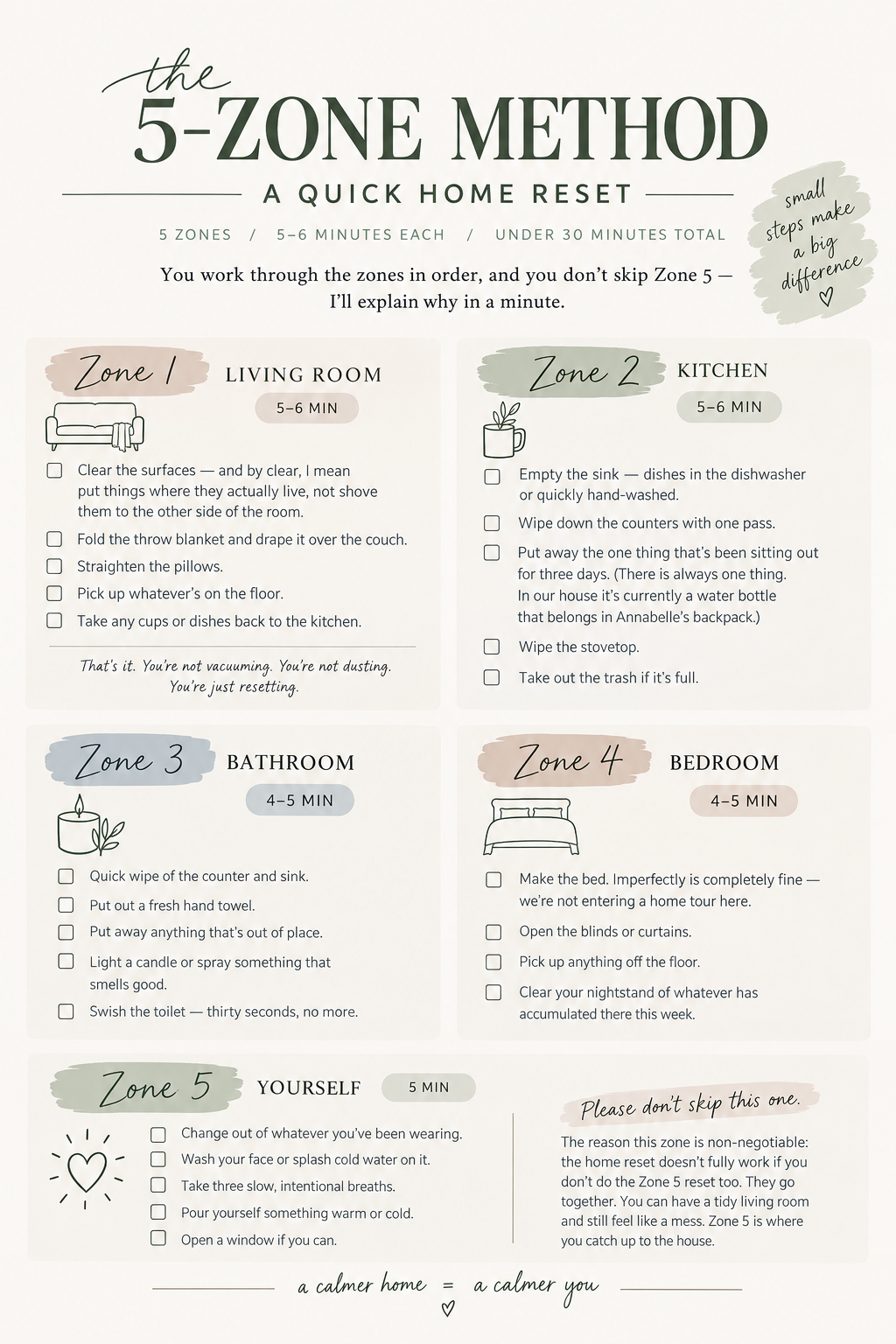
The reset covers five zones. Each one takes five to six minutes. Total time: under 30 minutes. You work through them in order, and you don't skip Zone 5 — I'll explain why in a minute.
Zone 1: Living Room (5-6 minutes)
Clear the surfaces — and by clear, I mean put things where they actually live, not shove them to the other side of the room. Fold the throw blanket and drape it over the couch. Straighten the pillows. Pick up whatever's on the floor. Take any cups or dishes back to the kitchen.
That's it. You're not vacuuming. You're not dusting. You're just resetting.
Zone 2: Kitchen (5-6 minutes)
Empty the sink — dishes in the dishwasher or quickly hand-washed. Wipe down the counters with one pass. Put away the one thing that's been sitting out for three days. (There is always one thing. In our house it's currently a water bottle that belongs in Annabelle's backpack.) Wipe the stovetop. Take out the trash if it's full.
Zone 3: Bathroom (4-5 minutes)
Quick wipe of the counter and sink. Put out a fresh hand towel. Put away anything that's out of place. Light a candle or spray something that smells good. Swish the toilet — thirty seconds, no more.
Zone 4: Bedroom (4-5 minutes)
Make the bed. Imperfectly is completely fine — we're not entering a home tour here. Open the blinds or curtains. Pick up anything off the floor. Clear your nightstand of whatever has accumulated there this week.
Zone 5: Yourself (5 minutes)
This is the one people skip. Please don't skip it.
Change out of whatever you've been wearing. Wash your face or splash cold water on it. Take three slow, intentional breaths. Pour yourself something warm or cold. Open a window if you can.
The reason this zone is non-negotiable: the home reset doesn't fully work if you don't do the Zone 5 reset too. They go together. You can have a tidy living room and still feel like a mess. Zone 5 is where you catch up to the house.
The Sensory Reset Layer
Once the five zones are done, this is what I call the sensory layer — and it's optional, but I highly recommend it.
Your senses are constantly picking up information about your environment. When you add something intentional — a smell you love, a sound that feels like exhaling, a change in light — your brain registers that a transition happened. The reset is complete. Something shifted.
For me, that means lighting my favorite candle, putting on a specific playlist that feels like a Sunday morning even when it's Wednesday, and opening at least one window. That combination signals to my nervous system: okay. We're okay.
Your version might look different. The point is to add something sensory that tells you the reset is done — not just done in the house, but done in you.
Why It Works Even When Life Doesn't
I want to be honest with you about something, because I think it matters.
The reset doesn't fix what's hard.
If something big is wrong — if you're in a difficult season, if you're carrying something heavy, if the problem is bigger than a messy living room — 30 minutes of tidying is not going to fix that. I know that. You know that.
But what it does is give you a place to breathe.
There was a day not long ago when I did the reset not because the house was messy but because I needed something I could control. The tidying wasn't the point. The act of moving through those zones, one thing at a time, zone after zone, gave me forward motion when everything else felt stuck. And when I sat down in a reset house with a cup of tea and three slow breaths, I felt — not fixed, but held. Like the space around me was on my side.
That's what the reset actually is. Not a cleaning system. A kindness you give yourself.
Take the Checklist with You
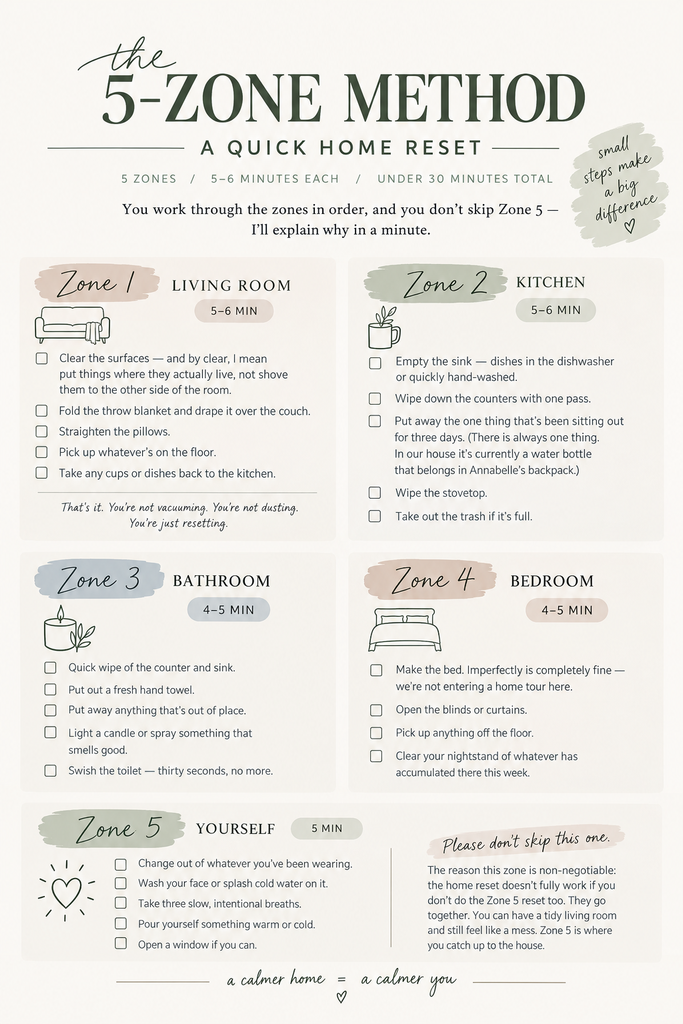
If you want to print this out and keep it somewhere you'll actually use it, I made you a free one-page checklist — all five zones, the sensory layer, everything on one page.
And if you try the reset this week, I want to hear about it. Come find me at @aligowdy and tell me which zone felt the best. (Spoiler: most people say Zone 5.)
You've got this. And your house does too.